#kettlbell has accumulated north of three million posts on Instagram. Your favorite fitspo is probably (most definitely) swinging and hoisting kettlebells overhead, and you’ve been officially convinced to swing and hoist kettlebells. If that sounds like you, you probably have run into an annoying and unexpected problem: Your grip sucks.
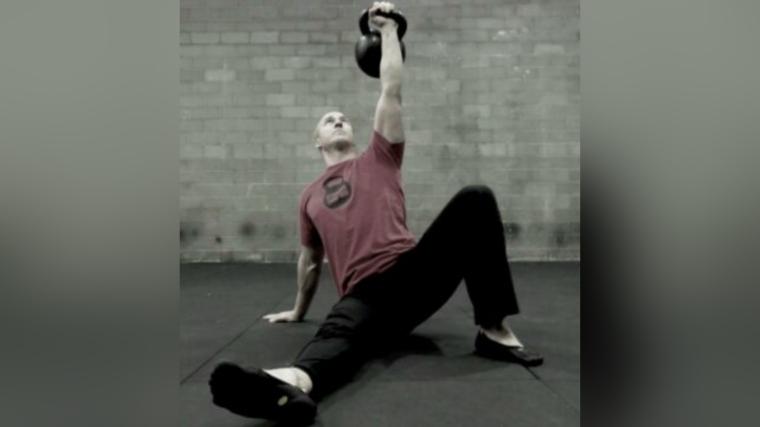
Kettlebells aren’t the easiest tool to grab, and the ballistic nature of many kettlebell movements makes them even harder to hang onto. What’s more, your ability to grip, and grip tightly, actually facilitate stronger and more powerful lifts. And it all starts with your muscle fascia.
The Importance of Grip
The fascial lines of the body are many and varied. This article isn’t intended to be a primer on fascia but on better understanding it to enhance our training. The arm lines are particularly relevant to our grip needs. There are four of these lines, and all play some part in grip and its effect on supercharging our performance.
This experiment uses the principles of irradiation of muscle tension to demonstrate just how vital grip is:
- Let your arms hang loosely by your side and notice where there is tension. Now make a fist. Notice it’s not just the muscles of the hand that are tight. The tension travels up your forearms.
- Now grip even harder. Notice the abdominals engage. Observe how the tension is now not just in your shoulders but also the muscles within your shoulders. How you grip grip has the potential to activate every muscle in your body.
Let’s try our experiment again, this time to demonstrate the importance of the arm lines:
- Grip as hard as you can, but focus on squeezing the thumb and index finger the hardest. You should feel the pec and delt engage forcefully.
- Now focus on gripping hardest with the little and ring fingers. This time you should feel the muscles in the back — the lats, rhomboids, and rotator cuff muscles — engage.
Applying this knowledge to exercise is common sense, yet few people do it. The conclusion to make from these tests is that if the body is ready for pushing (via the pecs and delts being engaged), your grip needs to have the index finger involved. The opposite applies to pulling motions, where we want to make sure that the pinky and ring finger are in direct contact with the bar or bell.
Hand Position for Smarter Grip
The most common hand position when using kettlebells is a grip that slides the wrist into the corner of the bell where the handle and body of the bell meet. This allows the handle of the bell to run diagonally across the hand and minimizes discomfort on the back of the wrist.
Then, most folks will close their index finger and thumb around the handle. You may mistakenly believe this grip is acceptable. It’s not acceptable. This grip will actually decrease performance while increasing injury risk.

Here’s why: During pressing, you need to address not only shoulder flexion but also shoulder stability. If the pinky doesn’t grip the bell, the rotator cuff won’t be fully engaged. And when it comes to swinging or pressing a heavy object overhead, you definitely want all the musculature of your shoulder to be engaged.
A better way to grip a kettlebell for pressing (or get-ups or snatching) is with the handle of the bell going directly across the hand, in line with the calluses. This grip allows both for use of the prime movers and for optimal function of the stabilizers.
Stronger Grip for Better Movement
If we extrapolate this for other kettlebell exercises, such as squats or swings, we can see these fascial lines connect the fingers to the muscles around the shoulder and also become muscles of the trunk on both sides. The front and back functional lines create two large Xs, one on the front of the body and one on the back.
The correct use of grip will switch on our postural control muscles and enhance all of our bigger lifts. For kettlebell squats, the flat grip is once again the better option (as opposed to the diagonal grip), since it activates the most support muscle.
Once you’re used to gripping this way, you’ll find your performance improves while your injury risk decreases. Changing your hand placement will perhaps make a difference in how much load you can move, but that shouldn’t be a concern unless you’re a powerlifter. Focus on how well your body can move and function as a unit.
More on Breaking Muscle:
- Get a Grip: 3 Ways to Grip a Deadlift and How to Get Your Grip Stronger
- More Insight Into Developing Grip Strength: Your Hand Digits
- Beyond the 2-Handed Swing: 5 Effective Kettlebell Movements You May Be Neglecting
The post This Kettlebell Grip Cue May Change Your Training for the Better appeared first on Breaking Muscle.
from Breaking Muscle https://bit.ly/3KWmcqA
via IFTTT
Comments
Post a Comment